
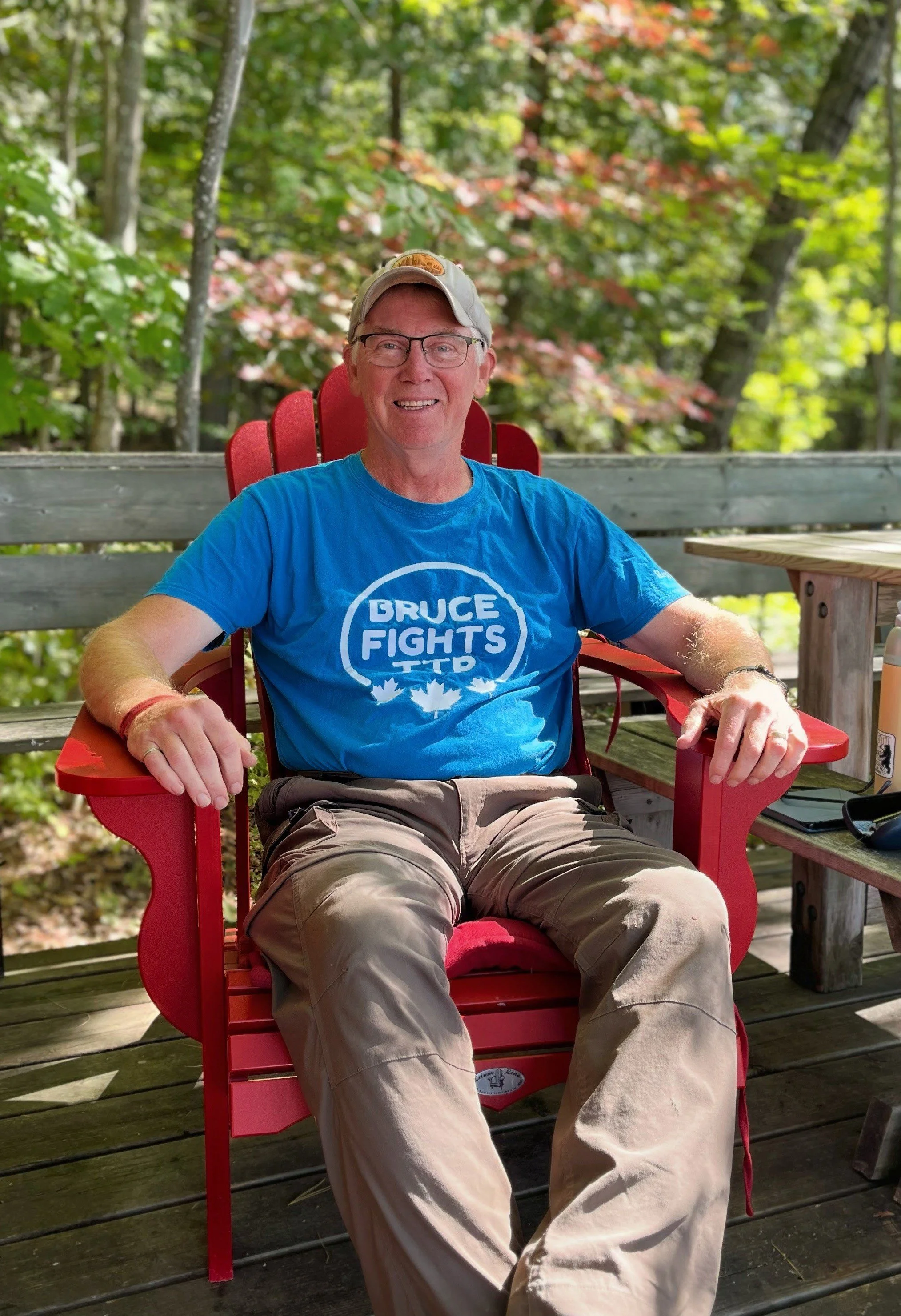
MY TTP STORY
By Bruce Morton • @BruceFightsTTP
My name is Bruce Morton. I am a 6-time, 14-year TTP veteran. My first episode was in 2012, my second in 2014, my third in 2017, followed by two episodes in 2019, and my last one was in 2022. I am not afraid of TTP. It is part of me—my body and mind have found a way to survive. I feel fortunate to have faced minimal long-term physical problems. I am not depressed, and I don’t live in fear of the next relapse.
Over the years, I have dealt with some loss of word recollection, which can make my responses slower while I search for the right word. Most people, even those closest to me, never quite get used to this issue, but it is a reality I navigate daily.
I was incredibly lucky in 2012. I assume most TTP survivors rely on luck when they first get sick. Because TTP is so rare, many emergency doctors have never encountered it, and patients are often misdiagnosed and sent home with dire consequences. For me, it took a couple of weeks to finally go to the hospital. I was enduring headaches, dark urine, the sniffles, a nosebleed, petechiae, heavy bruising, shortness of breath, and finally, a loss of speech.
Once hospitalized, I was diagnosed quickly, but the facility lacked an apheresis clinic, requiring an urgent transfer. During my stay, I suffered a stroke and a seizure, and discovered I have a severe anaphylactic allergy to fresh frozen plasma transfusions—not ideal for a TTP patient. I ended up in the ICU twice. I may have been one of the very first patients in Canada to receive solvent-detergent plasma, right before it began wider distribution across the country. Ultimately, it took 40 rounds of plasmapheresis to get me stable. Despite all of these complications, I was well enough to return to work in just over two months, though the seizure cost me my driver’s license for seven long months.
In 2014, TTP struck again. This time, I was hospitalized for two weeks, required 10 rounds of plasmapheresis, and returned to work in six weeks. However, I developed a deep vein thrombosis (DVT) in my left leg, which meant injecting blood thinners into my lower abdomen. Some fun—and a lot of bruises!
In July 2017, we were on vacation when the familiar bruising appeared. We were at the hospital four hours later. I underwent plasmapheresis through my arms for nine straight days. With all the needle holes and bruising, I looked like a serious addict. The good news was that my platelets climbed over 200, so the medical team gave me a weekend reprieve. The bad news? I suddenly suffered a retinal detachment, and my platelets plummeted back down to 39. We had to start all over again, this time with a central line in my neck.
WHAT I HAVE LEARNED DURING MY TTP TENURE
1. You cannot forecast a TTP relapse by tracking platelets alone.
Platelet counts only tell you a crash is already happening. The true way to monitor TTP is by measuring your ADAMTS13 activity . When this essential enzyme drops below 10% of normal levels, a TTP episode is triggered. ADAMTS13 levels change much slower than platelets, making it the perfect early-warning metric to track.
2. Rituximab is a game-changer.
While originally a cancer drug, it is highly effective at preventing TTP relapses. Clinical guidelines recommend that TTP patients receive Rituximab proactively when their ADAMTS13 activity dips below 20%. When an active episode occurs, Rituximab is crucial for keeping the disease at bay long-term. We must ensure all TTP patients have seamless access to it.
3.The Power of Caplacizumab (Cablivi.
While it doesn't stop or cure TTP directly, it prevents platelets from clumping together into dangerous clots. This protects a patient's vital organs from the devastating complications I experienced—like strokes, seizures, DVTs, retinal detachment, and kidney failure. It buys precious time for steroids, plasmapheresis, and Rituximab to take effect. I am incredibly grateful that Caplacizumab is approved and accessible for TTP patients across Canada.
That is my TTP story. I am profoundly lucky to have a wonderful wife and an awesome family who took care of me when I needed it most.
If you have the opportunity, please give blood, donate to TTP research, and give thanks for your health.